
TP-Link EAP670 AX5400 Ceiling Mount WiFi 6 Access Point
TP-Link EAP670 AX5400 Ceiling Mount WiFi 6 Access Point
Description
Features
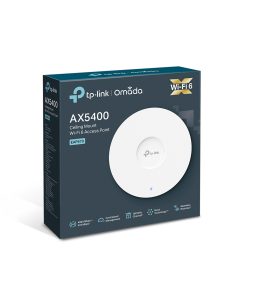 The TP-Link EAP670 AX5400 Ceiling-Mount Access Point is designed to deliver high-performance, enterprise-grade wireless connectivity for modern environments where speed, stability, and scalability are critical. Built on Wi-Fi 6 (802.11ax) technology, this access point targets offices, hotels, educational institutions, retail spaces, healthcare facilities, and large homes that demand reliable coverage and the ability to handle dozens or even hundreds of simultaneous wireless devices. The ceiling-mount form factor allows discreet installation, optimal signal propagation, and professional cable management, making it ideal for commercial deployments where aesthetics and performance must coexist. With combined wireless speeds of up to 5400 Mbps, the EAP670 represents a significant leap over legacy Wi-Fi 5 access points, enabling smoother cloud applications, high-resolution video conferencing, and uninterrupted connectivity in dense user environments.
Wi-Fi 6 Technology and AX5400 Performance Architecture
At the heart of the EAP670 is Wi-Fi 6, which introduces fundamental improvements over previous generations rather than incremental speed boosts alone. The AX5400 rating reflects its dual-band capability, with high throughput on both 2.4 GHz and 5 GHz bands. Wi-Fi 6 leverages technologies such as OFDMA, MU-MIMO, and 1024-QAM to ensure efficient spectrum utilization and consistent performance even under heavy load. Instead of devices competing for airtime, OFDMA allows the access point to serve multiple clients simultaneously within a single transmission cycle, dramatically reducing latency. This architecture makes the EAP670 particularly well-suited for environments with many smartphones, laptops, tablets, IP phones, and IoT devices connected at the same time, all requiring stable and responsive network access.
Ceiling-Mount Design and RF Coverage Optimization
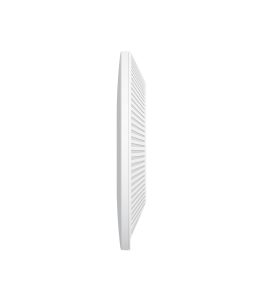
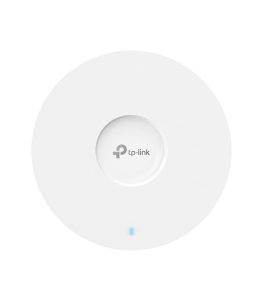 The ceiling-mount design of the EAP670 is more than a cosmetic choice; it plays a crucial role in radio-frequency performance. By positioning the access point above users, signals can radiate evenly across the coverage area without being blocked by furniture, partitions, or human bodies. This placement results in more uniform signal strength and fewer dead zones compared to wall-mounted or desk-based devices. The internal antenna configuration is engineered to provide balanced coverage across open spaces such as office floors, classrooms, corridors, and conference halls. The slim, low-profile enclosure blends seamlessly into commercial ceilings, allowing IT teams to deploy enterprise-grade Wi-Fi without disrupting interior design or drawing unnecessary attention to network hardware.
High-Density Connectivity and Multi-User Efficiency
One of the defining strengths of the TP-Link EAP670 is its ability to maintain performance in high-density environments. In modern workplaces and public venues, dozens of users may connect simultaneously, each running bandwidth-intensive applications such as video calls, cloud storage sync, or streaming services. Thanks to MU-MIMO and OFDMA, the EAP670 can communicate with multiple devices at once, rather than sequentially, significantly improving aggregate throughput and reducing congestion. This ensures that performance remains consistent even during peak usage hours. For organizations hosting meetings, training sessions, or customer-facing services, this level of multi-user efficiency translates into fewer complaints, higher productivity, and a more professional digital experience.
Seamless Integration with Omada SDN Ecosystem
 The EAP670 is part of the Omada Software-Defined Networking ecosystem, which allows centralized management of multiple access points, switches, and gateways from a single interface. Through Omada, administrators can configure SSIDs, apply security policies, monitor network health, and perform firmware updates across an entire site or multi-site deployment. This centralized approach simplifies network management, reduces operational overhead, and minimizes configuration errors. Whether deployed in a single office or across multiple branches, the EAP670 can be scaled easily without redesigning the network architecture. This makes it an attractive choice for growing businesses that want enterprise-level control without enterprise-level complexity.
Advanced Security and Network Segmentation Capabilities
Security is a core consideration in the design of the TP-Link EAP670. The access point supports modern encryption standards and authentication methods to protect sensitive data and prevent unauthorized access. Features such as WPA3 enhance protection against brute-force attacks, while secure guest networking allows visitors to access the internet without exposing internal resources. Network segmentation through multiple SSIDs and VLAN tagging enables administrators to separate employee traffic, guest traffic, and IoT devices, reducing security risks and improving traffic management. These capabilities are particularly valuable in environments such as offices, hotels, and educational institutions, where different user groups require different levels of access and control.
Power over Ethernet and Simplified Deployment
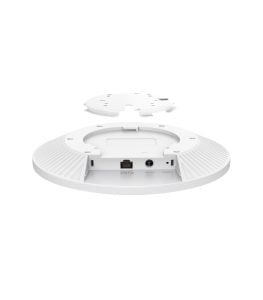
The EAP670 supports Power over Ethernet, allowing both data and power to be delivered through a single Ethernet cable. This greatly simplifies installation, especially in ceiling-mounted scenarios where access to electrical outlets may be limited or impractical. PoE reduces cabling clutter, lowers installation costs, and provides flexibility in access point placement. For IT teams, this means faster rollouts and easier reconfiguration when network layouts change. In addition, centralized PoE switching allows power to be managed and monitored from the network core, improving reliability and enabling features such as remote rebooting of access points when needed.
Reliability, Stability, and Enterprise-Grade Build Quality
 Designed for continuous operation, the TP-Link EAP670 emphasizes reliability and thermal efficiency. The internal hardware is engineered to handle sustained high throughput without overheating or throttling, ensuring consistent performance over long periods. This is critical in business environments where downtime or unstable connectivity can directly impact operations. The access point’s firmware and hardware are optimized to deliver stable connections, fast roaming between access points, and minimal packet loss. For organizations that rely on cloud services, VoIP systems, and real-time collaboration tools, this level of reliability is essential for maintaining smooth day-to-day operations.
Real-World Use Cases Across Different Environments
The versatility of the EAP670 makes it suitable for a wide range of deployment scenarios. In corporate offices, it supports collaborative workspaces, video conferencing rooms, and flexible seating arrangements without sacrificing performance. In educational institutions, it can handle dense student populations using laptops and tablets simultaneously. Hospitality venues benefit from its ability to deliver secure guest Wi-Fi while keeping internal systems isolated. Retail environments can rely on stable connectivity for point-of-sale systems, inventory management, and customer Wi-Fi access. Even large residential properties can take advantage of its enterprise features to build a robust, future-proof home network.